Publican, NOT RE-publican
You Can Call It Democrat if You Want

I opened the garage door. Tubs, and tubs everywhere. Stacked on top of each other. The greenhouse, the side room and the two-car garage was packed. Clothes hung on makeshift lines in the carport. Half of them on the cement floor getting soaked.
Julie made her way down every table emptying out glassware that had filled with rainwater, and Kim struggled to pull the opened tent off of the garage roof. It seemed an overwhelming disaster, but as we lined up the tubs and took off the lids, the people began to arrive. Let me explain…
The Wreckage
The first day of our estate sale was in ruins from the morning storms. Arkansas weather is as unpredictable as teen-age daughters. Predicted outcomes come a day before, or the day after, or not at all. Our plans were dicey we knew, but we went forward with the idea. Straight-line winds smacked the entire set up, carefully prepared the day previous. What a mess.
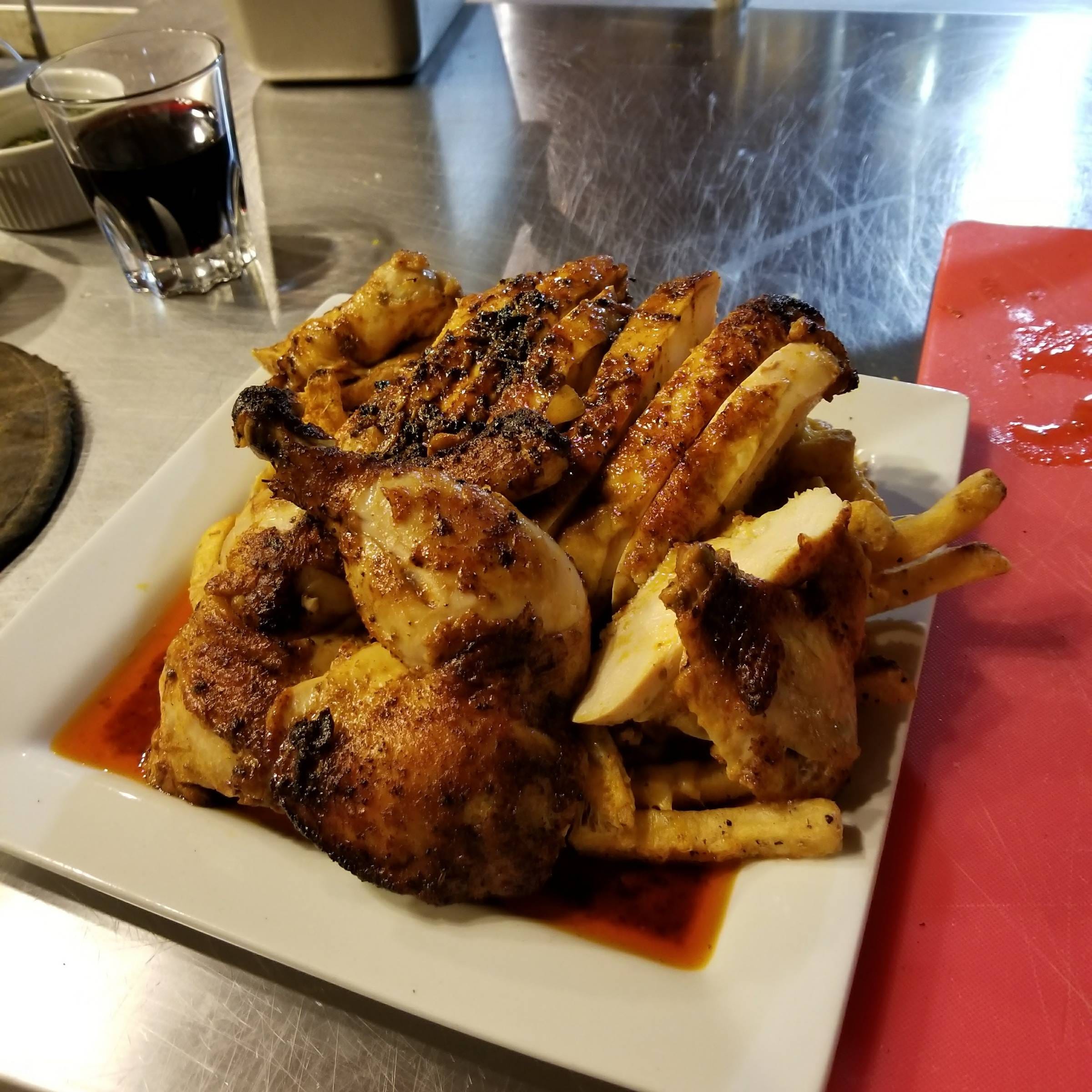
Several days before the wildness that had our clothes strewn about the lawn, a very special grill arrived and I had plans for it. My soul hearkened back to the second year of Fox and Fork when I clicked the ‘purchase’ button on the grill. I dreamt of perfectly crisp chicken skin, with light charring around the edges. A squeeze of lemon, and the smokey sweet flavor of paprika and brown sugar. I was dreaming of Publican Chicken. I unashamedly added it to special nights for Fox and Fork, almost straight out of the book titled ‘Cheers to the Publican: Repast and Present’. It’s an amazing book, and I highly recommend picking up a copy.
There were a lot of misconceptions about the dish when we first introduced it, and I found myself a number of times explaining that it wasn’t ‘Republican’, it was ‘Publican’. A publican is a person who visits ‘Pubs’, despite the fact we weren’t technically a pub, we definitely had the vibe for it. Either way, the folks loved it. Publican Chicken was such a hit our own tribe of ‘publicans’ often called to ask, “Hey, are you doing that chicken thing tonight?”.
As with many of my recipes, this one needed a few changes to work in our galley, as it was designed for the grill. A grill using real lump charcoal. Not those quasi-toxic compressed briquettes, but real lump charcoal. Huge difference. Hence the purchase of my ‘cowboy grill’. I wanted to do it over coals, as it was intended. Due to the prep-work for the estate sale and the ravenous storms, the grilled version will have to wait, but if you are so inclined to experimentation, here are the nuts and bolts of the most amazing whole chicken I’ve ever had. Except that one time at a real Hispanic tienda, which is another story. And the fact they used an actual grill. A big one.
Why This Works
Everything in this marinade makes the whole thing work, but it’s that extra hit of grilled lemon at the end that seems to kick things off. More importantly the spatchcocking and partially de-boning helps the chicken cook rather quickly and evenly, so the thighs are done when the breasts are. This keeps the entire bird from drying out. Spatchcocking a chicken (in my opinion) ranks up there with one of those essential skills every cook should know by heart. Every turkey I have cooked for the past ten years or so was spatchcocked. There are dozens of videos online illustrating the process, and with a little practice you’ll not only be able to do it in your sleep, but you’ll want to practice on other birds. Turkey, ducks, Cornish hens, even quail. (I’ve done them all at the restaurant.). Bonus points if you save your bones for stock later.
Build Notes
If you attempt this on the grill, you may experience varying cooking speeds. You’ll have to brush up on your grill-master skills. The process is a little more controlled using the stove top and a preheated 450 degree oven. Those are the cooking times I’ll include here.
The original recipe uses piment d’Espelette, but I prefer smoked paprika. As you may have already learned I am ridiculously addicted to it. I know the former is more nuanced, but I want more of that smoky earthiness that I have grown to love from good pub food.
The other alteration I make here is replacing the oregano. Yes, oregano is perfectly fine and delicious in it’s own right, I prefer once again, the earthiness of fresh marjoram, which I feel is more subtle than oregano. I feel oregano can be very loud in this preparation. I emphasize the word fresh here, because dried marjoram doesn’t move all that well at storefronts so only God knows how long it’s been sitting there. I’ve had some truly horrendous encounters with marjoram from the store. Which is why I took to growing my own. Oregano works just fine.
Build Options
I’ve never varied this particular recipe’s build options because it is so perfect, however you might want to play with sides. A possible fun variation could be to substitute several smaller Cornish hens.
At the restaurant we quartered the cooked bird and plated it atop of a huge pile of sea-salt and cracked black pepper french fries (frites). Absolutely the epitome of pub food. (hence ‘publican’).
The Recipe
One whole chicken spatchcocked and partially deboned
Marinade:
1/2 cup olive oil.
3-4 tablespoons of lemon juice. Fresh squeezed.
4 tablespoons of fresh marjoram. (only one tablespoon if using dried marjoram or oregano).
3-4 cloves of garlic, sliced. Heck, if you want more, go for it.
1 tablespoon of dark brown sugar
1/2 teaspoon of salt
1/2 teaspoon of course cracked black pepper.
1 lemon cut in half (not lengthwise)
The Process
The Marinade: Incorporate all the marinade elements (except the halved lemon) well, and slide your bird into a large ziplock bag. Pour in the marinade and seal it. Keep it in the fridge for twenty four hours, or overnight.
About an hour before you plan to cook, take out the bag o’ chicken and set it on a board. We are just trying to knock off the chill a little so it doesn’t cool our pan down too much.
Cook Oven Version:
Pre-heat your oven to 450, with a cast-iron skillet inside.
Pull out your pan and place it on the range with a low flame.
Pour enough olive oil to coat the bottom of the pan.
Place your chicken the pan skin-side-down. Listen for the sizzle.
As the sizzle diminishes, you’ll want to raise your heat. Don’t let the pan get cold.
As the skin releases from the pan, use your tongs to peak under the chicken, you’ll want to see the skin start to get golden. This takes about five minutes.
Put the pan in the 450-degreee oven for about eight minutes.
Pull our your pan and peak underneath it again to ensure it’s not burning.
Flip the chicken, meat-side down and over low heat on the stovetop. Let it cook for another four to five minutes.
Put back into the oven to finish off for about five more minutes.
Use a meat thermometer and once the thickest part of the meat reaches 160 degrees it’s done.
Carefully take the chicken out of the pan and let rest on a cutting board for a few minutes.
While the chicken is resting place your halved lemons cut-side down into the pan and get a char, if you can. There will be juices in the pan and you’ll definitely want to save that.
As the juices are reducing over very low flame, quarter your chicken up, and place over potatoes, french fries, tater tots, or just on a plate. Stack them neatly, make ‘em look pretty.
Pour the pan juices over the whole thing and squeeze your charred lemon halves over the chicken then serve.
The grill version is very similar, without the additional pan juices to depend on. Grilling the lemon halves should be easier however. You are looking for a golden crusted skin, and that 160 degree done temperature.
Notes
The pinnacle of chicken breeds is something called the Poulet de Bresse. It’s a French breed protected by the appellation d’origine contrôlée, a government organization designed to protect national breeds. No one could get one of these chickens without going through French means. They have characteristically slate-blue feet and are supposed to taste more…chicken-y than any other chicken. Some would argue there is an older variety (I actually used to raise, and they’re delicious) called Red Dorking which hails all the way back to ancient Rome. They’re rare but absolutely amazing animals, and sport a fifth toe. This extra toe denotes their pedigree or their ancientness. It is said the Dorking was the first chicken domesticated. It was rumored some time ago that some folks smuggled fertile Poulet de Bresse eggs out of France to begin raising in the United States. Shortly thereafter Canadian and Californian varieties called ‘Blue Footed Chickens’ or ‘Poulet Blue’ began to show up. You can try a Poulet De Bresse for around $62 plus shipping, but I think for now I’ll stick to the plain Cornish Cross in the grocery store for about eight bucks.
Extra
This sort-of memoir of Fox and Fork has been an awesome project, but it has always been part of something much bigger.
In the next few weeks I will be folding the Fox and Fork memoirs with something I am calling ‘The Field Almanac’. (note the similarities). The concept of Fox and Fork was to wrap my arms around something real, and tactile. To get away from the invisible digital.
This other work is on a platform more suited to my writing style. So in the interest of making my writing more accessible, I will be moving these memoirs over to the new Substack platform.
I’m still working out a few kinks, but you will still be getting this great Fox and Fork content, with a bit more. Check it out at: ‘The Field Almanac’