A Heuristic Remedy
Bone Broth Part I


Of Carnivores
One day I’ll be food for worms. Fungi, beetles, moths, and ants will have their fill. Their deaths will feed wheat, barley, then venison and bovine. A pathway of prevalence to paradox. Every end simultaneously begins. Moments after a body, hits the ground the flies gather to commune a feast. Everything is a carnivore. From my marrow to my flesh they will feast. Macabre and horrific as it seems, it is the nature of things. The sheep bleats helplessly, as its crimson claret drains onto the earth and the process begins.
Let me explain...
Stripping Away
My latest obsession in the Field Ethos has stoked the fires of imagination for me as a chef committed to using the whole animal. I’ve been binging their podcast, and feel like I’ve found a home of sorts. I am not a hunter, but these guys are. On occasion, while either listening or reading I find myself whisked away on some cold prairie parting out an elk. My chef brain takes over. Bones over here, back strap over there, and in the process of stripping down a freshly killed animal I feel I am simultaneously stripping away the cellophane and Styrofoam of post-modernism.
My prairie fantasy is more than some windy, wild-eyed, western romanticism. It is a connection to the beasts we kill. I’m here in this fantasy because I want the bones, sinew, silver skin and an escape from sterile Styrofoam and cellophane. Away from the maze of lab-controlled corridors where animals walk, wander and wait for their place on the killing floor.
This viscera -- simmered in water for hours, as nutrients and minerals leach delicately into the watery suspension -- is more than desired. It’s necessary. Humans have known this for millennia.
The Bleak Midwinter
Seems that every year around January, I find my inbox filled with requests for the Fox and Fork bone broth. Our family restaurant had committed itself to its in-house preparation. We made hundreds of gallons of the stuff. While fierce battles are waged over the definitions of broth, stock, and soup, Fox and Fork kept it simple. Chickens, in the pot, an overnight simmer over nothing more than the pilot light on the range.
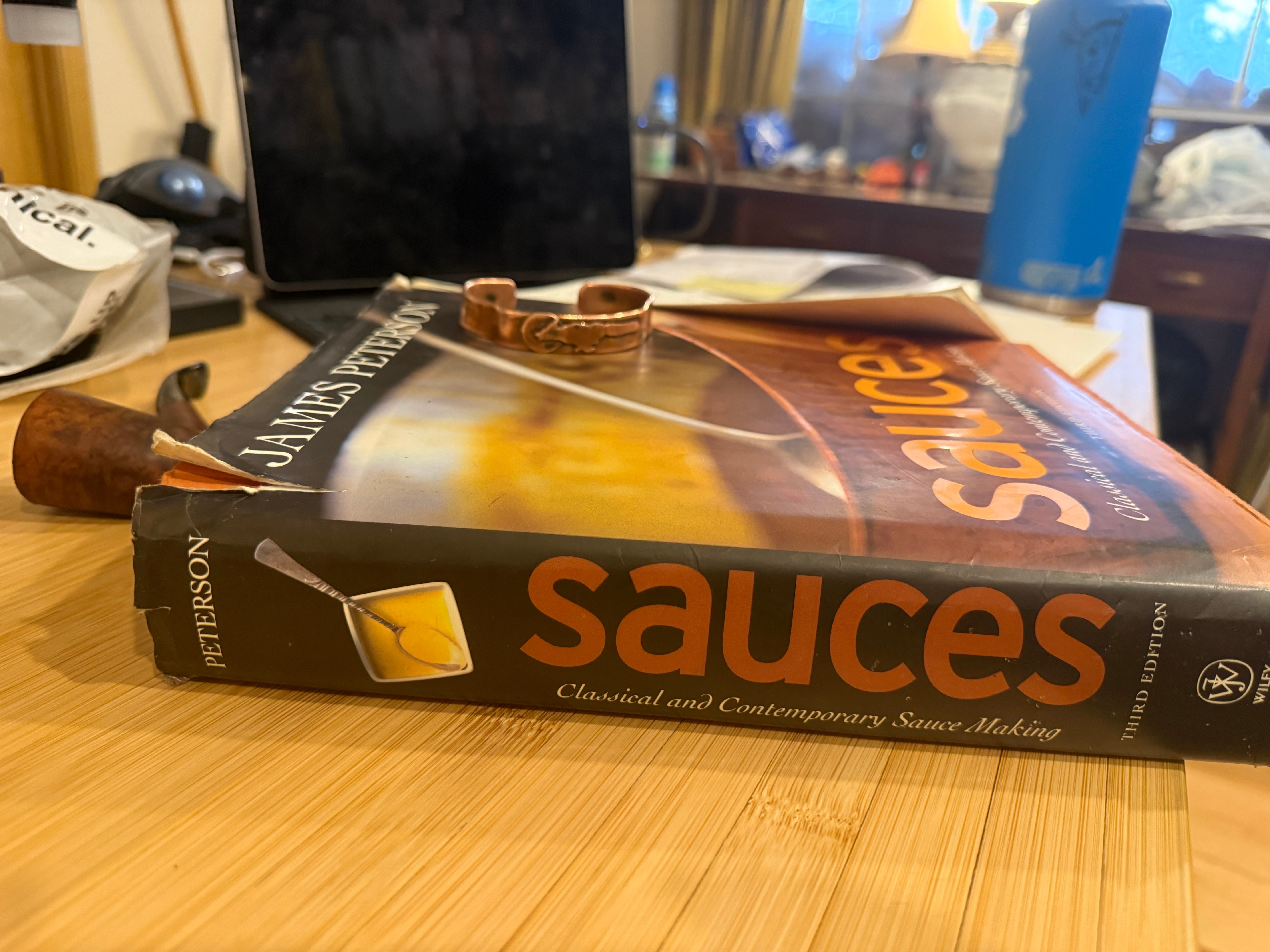
However, if one’s appetite demands a comprehensive understanding on how all this ‘stock-broth’ stuff works the book simply titled; Sauces by James Peterson will elicit snoring in front of the fire, or build the foundation of a much larger tome of knowledge. Either way in light of the nutritive hype, (everyone is trying to dodge the flu) the reason one should make this is because it’s damn good!
Why This Works
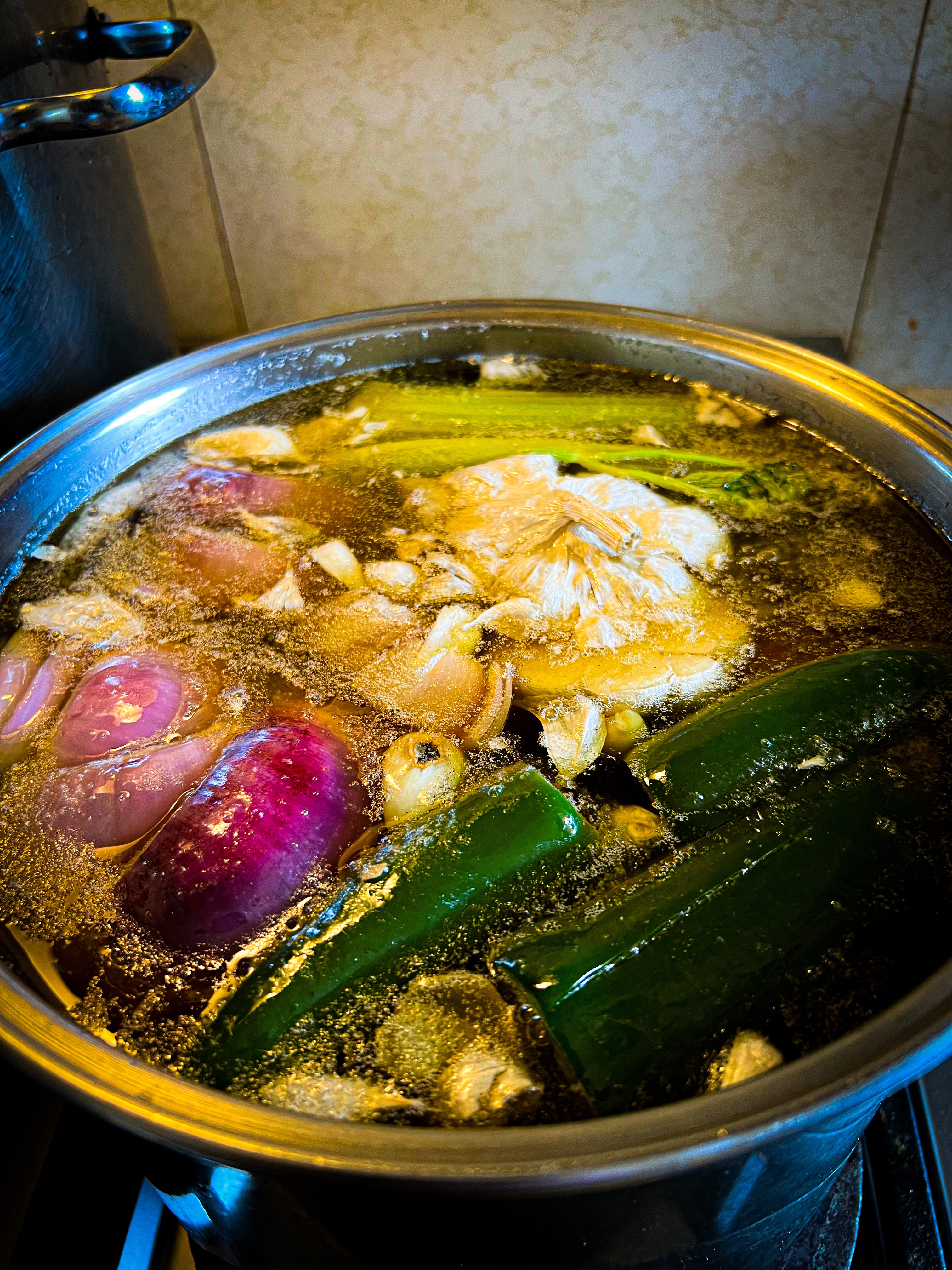
What follows is my simple heuristic (quick and dirty) approach to a robust broth. Any grocer worth a shit will have some version of rotisserie chicken available. This works on a number of levels because as discussed before it is very difficult sourcing bones, sinew and cartilage. But a whole chicken is pretty much available everywhere and has all the necessary components. To make it even easier for the squeamish most grocers will even cook the thing. Since the chicken is pre-cooked it most likely already has the seasoning applied.
Obviously there is a LOT to unpack when discussing the nuances of making bone broth, but here, we’re going to keep it simple.
Every person will have to adjust their cooking methods, as the heat source may vary. I have made stock over just about every heat source imaginable. The easiest method is with a slow cooker.
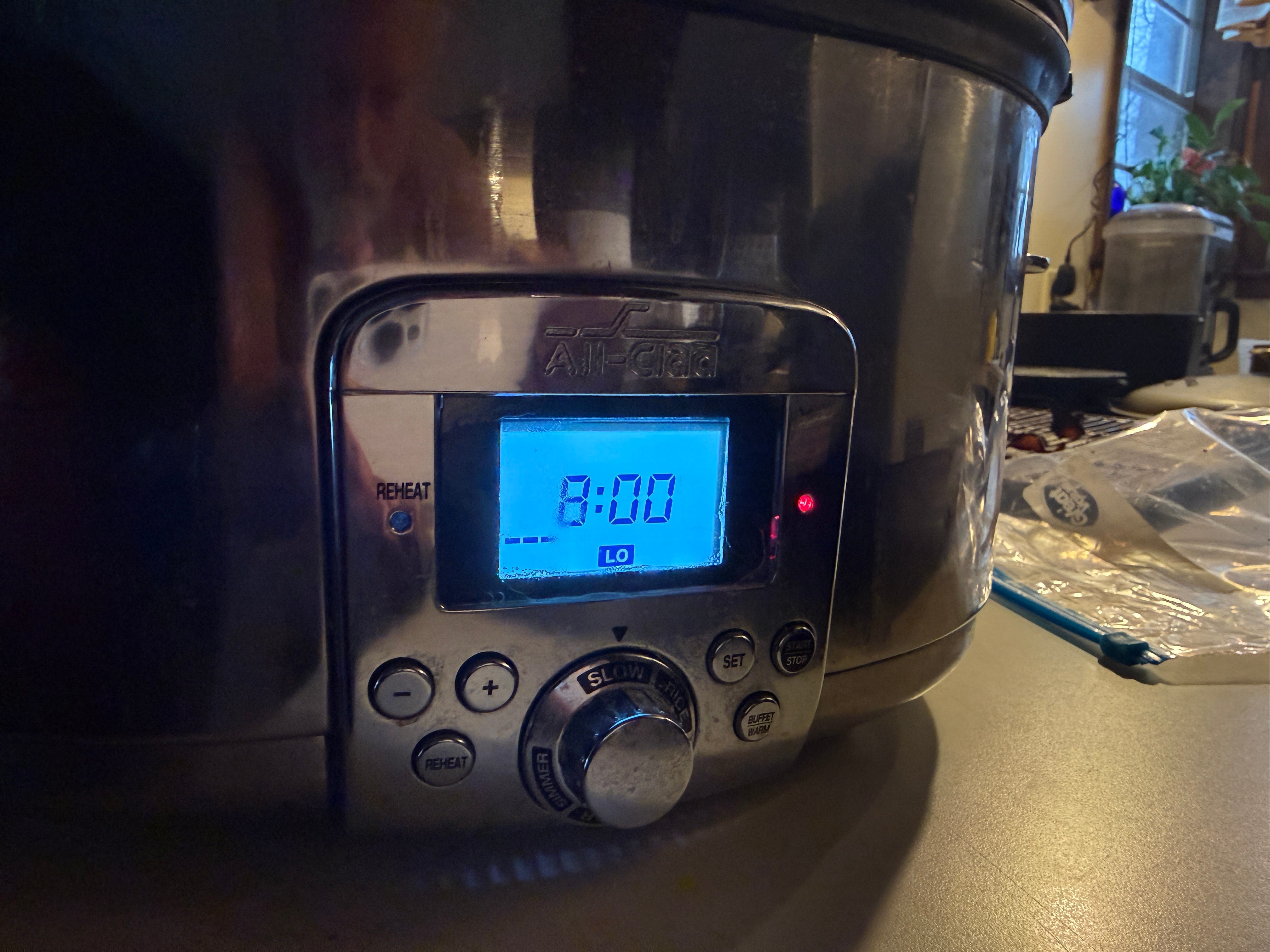
This particular slow cooker has a timer for eight hours, but keeping the lid on will keep it safe until I get home from work and set it for another eight hours. Just before bed I set it again for another eight hours. In the morning I set it again.
I will sometimes repeat this process for three days or so. But honestly, this stuff is ready to go in about four hours. The key is to get all the chicken pieces in contact with water so that nutritious delicious goodness gets into the mix.
The Recipe
One or more rotisserie chickens.
Cold, clean water
Salt (to taste)
Pepper (to taste)
The Process
Get an adequate sized pot. (or the slow-cooker insert)
Tear the chicken into pieces.
Cover with cold water.
Put the whole thing over the lowest heat source available. (or in the slow cooker)
Put a lid on the pot (slow cooker).
Wait for four hours.
Finishing
Finishing the stock is just as varied as the entire procuring, cooking and seasoning process. We’re going to keep it simple.
For straining the stock it really depends. I strain through a basic sieve, because I don’t mind if some of the stray bits and bobs are floating around. However I _DO_ separate the meat from the bones. Even though the meat is ‘spent’, it still has some nutritive value and can be used in a number of preparations. I personally save this spent meat for my massive Great Pyrenees. He loves it. The bones however have become brittle and sharp during the cooking process so those go in either the trash or buried in my raised beds.
The Best Stuff
It’s difficult, because what we are really doing here is creating an ingredient. One that can simply be bought in a box at any supermarket. So what’s the point? Why would a person grow their own tomatoes, cultivate an herb garden, or cook their own meals? Why hunt, fish, or gather at all?
Obviously it’s far cheaper just to buy the stuff where accountants have calculated the cost of a single egg and its means of production.
We could simply stand in front of the refrigerated section behind the veil and pick through cellophane, and Styrofoam.
We do it, because it’s the best stuff. There is a phrase, “Money can’t buy love, or a vine-ripened tomato.” With our perfectly adjusted tinfoil hats there is most likely the distrust of a post-modern approach to real food. We’ve lived for awhile under the ridiculously contrived ‘food pyramid’, and have found it wanting.
Somewhere, behind the veil it’s important to have that connection to death, and the life that it brings. Somewhere in our primordial brains we understand we are more than just fungi, waiting for trees to fall.